Reliefography
O Museu Van Gogh, em cooperação com a Fujifilm, desenvolveu uma técnica para a produção de cópias tridimensionais de famosas obras de Van Gogh. Essas reproduções são chamadas Relievos, e são tão parecidas com os originais que são vendidas com um selo inquebrável, para que ninguém venda como uma obra original.
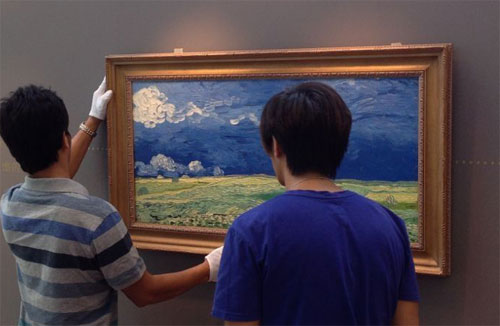
A coleção Relievo possui as seguintes obras: Almond blossom (1890), Sunflowers (1889), The harvest (1888), Wheatfield under thunderclouds (1890) e Boulevard de Clichy (1887), e foi lançada em Hong Kong em julho deste ano.
Essa técnica especial de 3d é chama Reliefography, e combina um escaneamento tridimensional da pintura e uma impressão em alta resolução. A obra reproduz não só a frente, mas também o fundo da tela e a moldura. Durante o processo de produção experts do Museu Van Gogh e da Fujifilm monitoram rigorosamente características como tamanho, cor, brilho e textura. E o curador do museu aprova o resultado final.
O museu pretende conseguir uma renda extra para o restauro e conservação de suas coleções, além de alcançar um novo mercado na arte e fazer parte da vanguarda tecnológica. Foram 7 anos de pesquisas para se chegar nessa tecnologia, e isso é visto na qualidade e no preço das reproduções, cada obra custa 22 mil libras.
Leia abaixo uma reportagem sobre essa nova tecnologia:
A poster of one of Van Gogh’s sunflowers is one of the traditional adornments to a student bedroom. The rest of us hang our reproductions in the knowledge that even the good ones are far from faithful to the originals – for which the going rate is £24m.
But not any more. The Van Gogh museum in Amsterdam has developed high-quality 3D reproductions of some of its finest paintings, with what it describes as the most advanced copying technique ever seen. Axel Rüger, the museum’s director, said: “It really is the next generation of reproductions because they go into the third dimension. If you’re a layman, they are pretty indistinguishable [from the originals]. Of course, if you’re a connoisseur and you look more closely, you can see the difference.”
Each reproduction is priced £22,000 – somewhat more than the cost of a postcard or poster. But the museum is hoping to increase access to pictures which, if they were sold, would go for tens of millions of pounds to Russian oligarchs or American billionaires.
The 3D scanning technique has so far reproduced Almond Blossom(1890), Sunflowers (1889), The Harvest (1888), Wheatfield under Thunderclouds (1890) and Boulevard de Clichy (1887). Further ventures into Van Gogh’s back catalogue are planned.
Other museums are taking a close interest in the commercial potential of 3D, given that the Van Gogh museum expects to raise substantial funds from sales. The revenue will go towards planned renovations, as well as the preservation of a collection of 200 paintings, drawings and letters. Rüger said: “It is really fascinating to start an ambitious and commercial product of this kind. For museums, the financial situation is such that we all need to think about new products, new income streams, new business ideas to secure our finances.”
The replicas, called Relievos, are being created by the museum in partnership with Fujifilm, with which it has had an exclusive deal for three years. Such is the complexity of the technology, known as Reliefography, that it has taken more than seven years to develop and only three a day can be made. It combines a 3D scan of the painting with a high-resolution print. The “super-accurate” reproduction even extends to the frame and the back of the painting. Every Relievo is numbered and approved by a museum curator. There is a limited edition of 260 copies per painting.
Rüger said: “This particular process has been developed with paintings in mind. The work of Van Gogh lends itself particularly well, since the pictures are so rich in surface structure. We have been working with them on the colour quality and fine-tuning.”
Asked whether those who could afford to pay £22,000 would prefer an original painting, even if by an artist other than Van Gogh, Rüger said: “These are separate markets.”
When the series was launched in Hong Kong last month, the museum’s curators chose a shopping mall rather than a gallery. “There was enormous interest there. We had people there who bought on the spot,” said Rüger. “For someone interested in Van Gogh, this is the closest you can get to the original without it being the original. There is a certain fascination about that.”
To ensure that no replica is passed off as the real thing, each is clearly marked with an unbreakable seal. The Relievos will also be used for educational purposes, in schools and for the visually impaired.
Fonte: Dalya Alberge para o The Guardian e http://www.vangoghmuseum.nl/vgm/index.jsp?lang=en&page=327966
Legado artístico é algo que se constrói ao longo da vida de um artista, mas…
O Centro Cultural Candido Mendes, tradicional reduto de experimentação e vanguarda artística em Ipanema, no…
O artista visual, animador cultural e diretor de arte Raimundo Rodriguez apresenta a exposição “Grandes…
Há uma ironia de trajeto em André Mogle. Conhecido pelo pulso largo do grafite paulistano…
Benjamin Rothstein costuma dizer que carrega certo estranhamento em relação ao mundo. Aos 73 anos,…
No final dos anos 1980, quando frequentava as salas da Escola de Artes Visuais do…